Sunday, September 22, 2013

In Praise of Art Forgery

Fakes say some interesting things about the economics of art
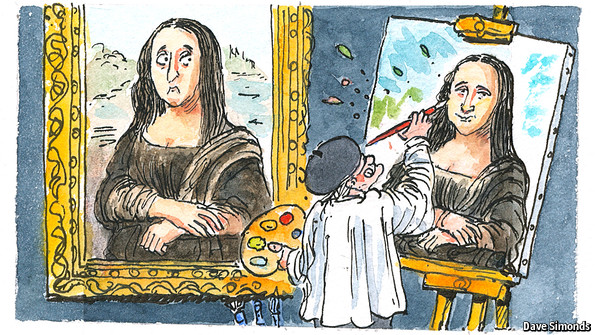
WHAT makes an artist great? Brilliant composition, no doubt. Superb draughtsmanship, certainly. Originality of subject or of concept, sometimes. But surely true greatness means that the creator of a painting has brought a certain je ne sais quoi to the work as well.
There is, however, a type of person who seems to sait perfectly well what that quoi is, and can turn it out on demand. In 1945, for example, a Dutchman named Han van Meegeren faced execution for selling a national art treasure, in the form of a painting by Vermeer, to Hermann Göring, Hitler’s deputy. His defence was that it was a forgery he had painted himself. When asked to prove it by copying a Vermeer he scorned the offer. Instead he turned out a completely new painting, “Jesus Among the Doctors”, in the style of the master, before the eyes of his incredulous inquisitors.
Göring, who was facing a little local difficulty at the time, did not sue van Meegeren. But that has not been the experience of Glafira Rosales, an art dealer in New York who admitted this week that she has, over the past 15 years, fooled two local commercial art galleries into buying 63 forged works of art for more than $30m. She is being forced to give the money back, and is still awaiting sentence.
A load of Pollocks
Ms Rosales is guilty of passing goods off as something they are not, and should take the rap for the fraud. But although art forgers do a certain amount of economic damage, they also provide public entertainment by exposing the real values that lie at the heart of the art market.
That art market pretends that great artists are inimitable, and that this inimitability justifies the often absurd prices their work commands. Most famous artists are good: that is not in question. But as forgers like van Meegeren and Pei-Shen Qian, the painter who turned out Ms Rosales’s Rothkos and Pollocks, show, they are very imitable indeed. If they were not, the distinction between original and knock-off would always be obvious. As Ms Rosales’s customers have found, no doubt to their chagrin, it isn’t.
If the purchasers of great art were buying paintings only for their beauty, they would be content to display fine fakes on their walls. The fury and embarrassment caused by the exposure of a forger suggests this is not so.
Expensive pictures are primarily what economists call positional goods—things that are valuable largely because other people can’t have them. The painting on the wall, or the sculpture in the garden, is intended to say as much about its owner’s bank balance as about his taste. With most kit a higher price reduces demand. But art, sports cars and fine wine invert the laws of economics. When the good that is really being purchased is evidence that the buyer has forked out a bundle, price spikes cause demand to boom.
All this makes the scarcity and authenticity that underpin lofty valuations vital. Artists forget this at their peril: Damien Hirst’s spot pictures, for instance, plummeted in value when it became clear that they had been produced in quantities so vast nobody knew quite how many were out there, and when the market lost faith in a mass-production process whose connection with the original artist was, to say the least, tenuous.
Ms Rosales’s career is thus a searing social commentary on a business which purports to celebrate humanity’s highest culture but in which names are more important than aesthetics and experts cannot tell the difference between an original and a fake. Unusual, authentic, full of meaning—her life itself is surely art, even if the paintings were not. (The Economist)

Sunday, September 15, 2013

After a Financial Flood, Pipes Are Still Broken


 This is a slightly longer article than usual but it is about the fifth anniversary of a major economic collapse.

By

 IT’S been five years since the bankruptcy filing of Lehman Brothers set off the worst economic crisis in the United States since the Great Depression. With the perspective that distance provides, it’s worth asking: Is our financial system safer and sounder today than it was back then?

Many of the nation’s bankers, lawmakers and regulators might well say yes, arguing that safeguards have been put in place to protect against another cataclysm. The voluminous Dodd-Frank law, with its hundreds of rules and new regulatory regimes, was the centerpiece of these efforts.
And yet, for all the new regulations governing derivatives, mortgages and bank holding companies, a crucial vulnerability remains. It’s found in our vast and opaque securities financing system, known as the repurchase obligation or repo market. Now $4.6 trillion in size, it is where almost every financial crisis since the 1980s has begun. Little has been done, however, to reduce its risks.
The repo market, also known as the wholesale funding market, is the plumbing of the financial system. Without it, money could not flow freely, and banks, brokerage firms and asset managers would not be able to conduct their trades and open for business each day.
When institutions sell securities in this market, they do so with the promise that they can be repurchased the next day — hence the “repo market” name. By using this market, banks can finance their securities holdings relatively cheaply, money market funds can invest cash productively and institutions can borrow securities so they can sell them short or deliver them in other types of trades.
Among the biggest participants that provide funding in this market are the money market mutual funds; they lend their cash to banks and other institutions, accepting collateral like mortgage securities in exchange. The money market funds accept a small amount of interest on these overnight loans in exchange for being able to unwind the transactions daily, if need be.
When markets are operating smoothly, most wholesale funding trades are not unwound the next day. Instead, they are rolled over, with both parties agreeing to renew the transaction. But if a participant decides not to renew because of concerns about a trading partner’s potential failure, trouble can arise.
In other words, this is a $4.6 trillion arena operating on trust, which can disappear in an instant.
Both Bear Stearns and Lehman Brothers collapsed after their trading partners in the repo market became nervous and stopped lending them money. For decades, the firms had financed their holdings of illiquid and long-term assets — like mortgage securities and real estate — in the overnight repo markets. Not only was the repo borrowing low-cost, it also allowed them to leverage their operations. Best of all, accounting rules let repo participants set aside little in the way of capital against the trades.
“It was a very unstable form of funding during the crisis and it is still a problem,” said Sheila Bair, former head of the Federal Deposit Insurance Corporation, and chairwoman of the Systemic Risk Council, a nonpartisan group that advocates financial reforms, in an interview. “The repo market is also highly interconnected because the trades are done between financial institutions.”
Some government officials have also voiced concerns recently about risks in the repo market. William C. Dudley, president of the Federal Reserve Bank of New York, referred to the issue in a February speech and Ben S. Bernanke, the Fed chairman, discussed the problems with wholesale funding in a speech in May. The Securities and Exchange Commission published a bulletin in July on the vulnerabilities in the repo market as they relate to money market funds.
Another problem in this market is that only two banks — Bank of New York Mellon and, to a lesser degree, JPMorgan Chase — dominate the business. There used to be a number of clearing banks, as the banks that stand in the middle of the trades are known, but the ranks have dwindled because of industry consolidation.
Unfortunately, these weaknesses remain. “A lot of things have been done to address a lot of specific problems but it doesn’t seem like anything has been done to address the overall problem of institutions losing access to financing,” said Scott Skyrm, a repo market veteran and author of “The Money Noose — Jon Corzine and the Collapse of MF Global.”
Mr. Skyrm said regulators appeared to be tackling the problem through a back door involving capital requirements. For example, new leverage ratios proposed by the international Basel Committee and United States financial regulators would require banks for the first time to set aside capital against the assets they finance in the repo markets. A recent report from J.P. Morgan estimates that under the Basel proposal, the eight largest domestic banks would have to raise $28 billion to $34 billion in capital relating to their repo business.
Banks are likely to consider an alternative: shrinking their repo operations. But the liquidity in this titanic market is essential for the government’s financing of its debt. As the J.P. Morgan report noted, trading volumes in the United States government bond market are closely linked to the amount of repos outstanding. So any contraction in the arena may reduce liquidity in the Treasury market.
SOME experts think that the answer to the repo problem lies in creating a central clearing platform that would allow all participants, not just the banks, to trade directly. Similar platforms have been mandated for derivatives under Dodd-Frank and could be constructed to support the wholesale funding market.
While such an entity would be a too-big-to-fail institution, so are the two banks now serving as intermediaries. And a central clearing platform could be set up as a utility, with officials monitoring transactions and requiring margin payments to finance bailouts in the event of a participant’s default.
Peter Nowicki, the former head of several large bank repo desks, is an advocate of this idea. “Repo is the last over-the-counter market that’s not headed toward central clearing and the Fed should mandate a change,” he said. “Should a large dealer have a problem or the clearing banks have an issue, the repo market could shut down.”
And that, five years after the Lehman collapse, would be an unconscionable failure.


Saturday, September 7, 2013

What Stock to Buy?

What Stock to Buy? Hey, Mom, Don’t Ask Me


OVER the last few weeks, as the stock market has reached new highs, my thoughts have turned to my 85-year-old mother.
“O.K. Mr. Smarty-Pants,” she often asks me, “what stock should I buy now?”
She first asked me this question when I was an undergraduate at Princeton, majoring in economics. She asked again when I was a graduate student at M.I.T., earning a Ph.D. in economics. And she has asked it regularly during the last three decades when I have been an economics professor at Harvard.
Unfortunately, she has never been happy with my answers, which are usually evasive. Nothing in the toolbox of economists makes us good stock pickers.
Yet we economists have written countless studies about the stock market. Here is a summary of what we know:
THE MARKET PROCESSES INFORMATION QUICKLY One prominent theory of the stock market — the efficient markets hypothesis — explains how answering my mother’s question would be a fool’s errand. If I knew anything good about a company, that news would be incorporated into the stock’s price before I had the chance to act on it. Unless you have extraordinary insight or inside information, you should presume that no stock is a better buy than any other.
This theory gained public attention in 1973 with the publication of “A Random Walk Down Wall Street,” by Burton G. Malkiel, the Princeton economist. He suggested that so-called expert money managers weren’t worth their cost and recommended that investors buy low-cost index funds. Most economists I know follow this advice.
PRICE MOVES ARE OFTEN INEXPLICABLE Even if changes in stock prices are unpredictable, as efficient markets theory suggests, we should be able to explain these changes after the fact. That is, we should be able to identify the news that causes stock prices to rise and fall. Sometimes we can, but often we can’t.
In 1981, Robert J. Shiller, a regular contributor to this column and an economics professor at Yale, published a paper in The American Economic Review called, “Do Stock Prices Move Too Much to Be Justified by Subsequent Changes in Dividends?” He argued that stock prices were too volatile. In particular, they fluctuated much more than a rational valuation of the underlying fundamentals would.
Mr. Shiller’s paper prompted a storm of controversy. My reading of the subsequent academic literature is that his conclusions, though not all his techniques, have survived the debate. Stock prices seem to have a life of their own.
Advocates of market rationality now say that stock prices move in response to changing risk premiums, though they can’t explain why risk premiums move as they do. Others suggest that the market moves in response to irrational waves of optimism and pessimism, what John Maynard Keynes called the “animal spirits” of investors. Either approach is really just an admission of economists’ ignorance about what moves the market.
HOLDING STOCKS IS A GOOD BET The large, often inexplicable movements in stock prices might deter someone from holding stocks in the first place. Many Americans, even some with significant financial assets, avoid stocks altogether. But doing so is a mistake, because the risk of holding stocks is amply rewarded.
In 1985, Rajnish Mehra and Edward C. Prescott, both now at Arizona State University, published a paper in the Journal of Monetary Economics called “The Equity Premium: A Puzzle.” They pointed out that over a long time span, stocks have earned, on average, about 6 percent more per year than safe assets like Treasury bills. This large premium, they said, is hard to explain with standard economic models. Sure, stocks are risky, so you can never be certain you’ll earn the premium, but they are not risky enough to justify such a large expected return.
Since the paper was published, economists have made some limited progress in explaining the equity premium. In any event, the large premium has convinced most of us that stocks should be part of everyone’s financial plan. I allocate 60 percent of my financial assets to equities.
Stocks may be an especially good deal today. According to a recent study by two economists at the Federal Reserve Bank of New York, given the low level of interest rates, the equity premium now is the highest it has been in 50 years.
DIVERSIFICATION IS ESSENTIAL Every time a company experiences a catastrophic decline — consider Enron or Lehman Brothers — reports emerge about employees who held most of their wealth in company stock. These stories leave economists slapping their heads. If there is one thing we know for sure, it is that sensible financial management requires diversification.
So, if you have more than 5 percent of your assets in any one company, call your broker and sell. Doing otherwise means exposing yourself to extra risk without extra reward.
SMART INVESTORS THINK GLOBALLY One widely documented failure of diversification is what economists call home bias. People tend to invest disproportionately in their home country.
Most economists take a more global perspective. The United States represents a bit under half of the world’s stock portfolio. Because Europe, Japan and the emerging markets don’t move in lock step with the United States, it makes sense to invest abroad as well.
Which brings me back to my mother’s question: If I could pick just one stock for someone to buy, what would it be? I would now suggest something like the Vanguard Total World Stock exchange-traded fund, which started trading in 2008. In one package, you can get low cost and maximal diversification. It may not be as exciting as trying to pick the next Apple or Google, but you’ll sleep better at night.
N. Gregory Mankiw is a professor of economics at Harvard.

Saturday, March 30, 2013

Too Big to Fail Banks are "Crony" Capitalism.


One phrase that became a household word as a result of the last financial meltdown is "too big to fail". Many have insisted that we need to break up all such banks while others have argued that the real issue is not one of size but one of interdependence i.e. a bank becomes more crucial to the economy when its failure will bring about a systemic failure and not only because it is large. The following article is a summary of the views of the president of the Dallas Federal reserve Bank who is a strong supporter of the view that the US does not have to put up with banks that are too big to fail. Read and comment.

************************************************************************************

The largest U.S. banks are "practitioners of crony capitalism," need to be broken up to ensure they are no longer considered too big to fail, and continue to threaten financial stability, a top Federal Reserve official said on Saturday.

Richard Fisher, president of the Dallas Fed, has been a critic of Wall Street's disproportionate influence since the financial crisis. But he was now taking his message to an unusual audience for a central banker: a high-profile Republican political action committee.
 

Fisher said the existence of banks that are seen as likely to receive government bailouts if they fail gives them an unfair advantage, hurting economic competitiveness.

"These institutions operate under a privileged status that exacts an unfair tax upon the American people," he said on the last day of the annual Conservative Political Action Conference (CPAC).

"They represent not only a threat to financial stability but to fair and open competition … (and) are the practitioners of crony capitalism and not the agents of democratic capitalism that makes our country great," said Fisher, who has also been a vocal opponent of the Fed's unconventional monetary stimulus policies.
Fisher's vision pits him directly against Fed Chairman Ben Bernanke, who recently argued during congressional testimony that regulators had made significant progress in addressing the problem of too big to fail. Bernanke asserted that market expectations that large financial institutions would be rescued is wrong.
But Fisher said mega banks still have a significant funding advantage over its competitors, as well as other advantages. To address this problem, he called for a rolling back of deposit insurance so that it would extend only to deposits of commercial banks, not the investment arms of bank holding companies.

"At the Dallas Fed, we believe that whatever the precise subsidy number is, it exists, it is significant, and it allows the biggest banking organizations, along with their many nonbank subsidiaries - investment firms, securities lenders, finance companies - to grow larger and riskier," he said.

Fisher argued Dodd-Frank financial reforms were overly complex and therefore counterproductive.
"Regulators cannot enforce rules that are not easily understood," he said.

(Reporting by Pedro Nicolaci da Costa; editing by Gunna Dickson)

Sunday, March 17, 2013

Microeconomics of Scarcity

Hose tripe

Banning hosepipe use is a poor solution to a water shortage

How should we respond to scarcity? Should we increase the price or should we issue rationing coupon? An interesting real world article from the Economist.
 
*********************************************************************************

SPRAY the begonias or flout the law? That is the dilemma facing gardeners in England after a hosepipe ban came into force on April 5th. Another dry winter means that water is in short supply: anyone caught using a hose to refresh a parched lawn or clean a dirty car faces a £1,000 ($1,600) fine. And if you happen to own an ornamental fountain, forget it.
The ban's aim is off. It targets how water is transported, not its consumption—which metering would do. The obsessive car cleaner can use hundreds of buckets of water without fear. Nor is the ban likely to be strictly enforced. The last time hoses were widely forbidden, in 2006, two in seven people ignored the rule. Water firms have abandoned plans to set up hose hotlines enabling customers to shop their neighbours. There is no sign yet of hose vigilantes.

The economics of the ban are all wrong, too. With low supply and high demand, prices in an unregulated market would rise. But the hose ban aims to reduce the quantity of water consumed while maintaining a cap on the price. In a forthcoming article, Jeremy Bulow of Stanford Business School and Paul Klemperer of Oxford University use theory to show that such price caps mean those who value a good most do not necessarily get it. And because they can't pay for it, consumers commit effort to finding other ways of obtaining what they want.

Indeed, the kind of behaviour predicted by theory is already visible. Dedicated websites provide lots of ideas for sidestepping the ban by exploiting loopholes in the law. Power-washing the patio is acceptable if motivated by health-and-safety concerns—to blast away potentially slippery moss, for example. Fountains may be allowed to flow, as long as they lead into ponds containing goldfish.

Another paper, by Tim Leunig of CentreForum, a think-tank, argues that heavy water users should be offered flexible contracts which would reward them for reducing usage in times of drought (farmers could plant less water-intensive crops, for example). They would be paid for each litre they forgo. That would leave the water company out of pocket but with more water. It could then sell this surplus to those that want it, at a higher price. An alternative would be to meter all water users, and to vary the price according to availability. That would, of course, mean installing meters in every house—which would be expensive, but probably a good idea anyway.

Sunday, March 10, 2013

Does Daylight Saving cost More Energy?

It is interesting to read the following and learn that there are some seious studies that have concluded that Day Light Savings does in fact cost more energy. Read and comment.


For decades, conventional wisdom has held that daylight-saving time reduces energy use. But a unique situation in Indiana provides evidence challenging that view: Springing forward may actually waste energy.
Ben Franklin may not having been saving much candlewax by springing forward.
Up until two years ago, only 15 of Indiana’s 92 counties set their clocks an hour ahead in the spring and an hour back in the fall. The rest stayed on standard time all year, in part because farmers resisted the prospect of having to work an extra hour in the morning dark. But many residents came to hate falling in and out of sync with businesses and residents in neighboring states and prevailed upon the Indiana Legislature to put the entire state on daylight-saving time beginning in the spring of 2006.

Indiana’s change of heart gave University of California-Santa Barbara economics professor Matthew Kotchen and Ph.D. student Laura Grant a unique way to see how the time shift affects energy use. Using more than seven million monthly meter readings from Duke Energy Corp., covering nearly all the households in southern Indiana for three years, they were able to compare energy consumption before and after counties began observing daylight-saving time. Readings from counties that had already adopted daylight-saving time provided a control group that helped them to adjust for changes in weather from one year to the next.

Their finding: Having the entire state switch to daylight-saving time each year, rather than stay on standard time, costs Indiana households an additional $8.6 million in electricity bills. They conclude that the reduced cost of lighting in afternoons during daylight-saving time is more than offset by the higher air-conditioning costs on hot afternoons and increased heating costs on cool mornings.
“I’ve never had a paper with such a clear and unambiguous finding as this,” says Mr. Kotchen, who presented the paper at a National Bureau of Economic Research conference.

A 2007 study by economists Hendrik Wolff and Ryan Kellogg of the temporary extension of daylight-saving in two Australian territories for the 2000 Summer Olympics also suggested the clock change increases energy use.

That isn’t what Benjamin Franklin would have expected. In 1784, he observed what an “immense sum! that the city of Paris might save every year, by the economy of using sunshine instead of candles.” (Mr. Franklin didn’t propose setting clocks forward, instead he satirically suggested levying a tax on window shutters, ringing church bells at sunrise and, if that didn’t work, firing cannons down the street in order to rouse Parisians out of their beds earlier.)

Sunday, March 3, 2013

Minimum Wage

An excellent must read article about minimum wages. I usually would not post back to back on the same issue but this is an exception. Enjoy the treat.

*********************************************************************************

Economic View

The Business of the Minimum Wage

RAISING the minimum wage, as President Obama proposed in his State of the Union address, tends to be more popular with the general public than with economists.
Mark Allen Miller
I don’t believe that’s because economists care less about the plight of the poor — many economists are perfectly nice people who care deeply about poverty and income inequality. Rather, economic analysis raises questions about whether a higher minimum wage will achieve better outcomes for the economy and reduce poverty.
First, what’s the argument for having a minimum wage at all? Many of my students assume that government protection is the only thing ensuring decent wages for most American workers. But basic economics shows that competition between employers for workers can be very effective at preventing businesses from misbehaving. If every other store in town is paying workers $9 an hour, one offering $8 will find it hard to hire anyone — perhaps not when unemployment is high, but certainly in normal times. Robust competition is a powerful force helping to ensure that workers are paid what they contribute to their employers’ bottom lines.
One argument for a minimum wage is that there sometimes isn’t enough competition among employers. In our nation’s history, there have been company towns where one employer truly dominated the local economy. As a result, that employer could affect the going wage for the entire area. In such a situation, a minimum wage can not only make workers better off but can also lead to more efficient levels of production and employment.
But I suspect that few people, including economists, find this argument compelling today. Company towns are largely a thing of the past in this country; even Wal-Mart Stores, the nation’s largest employer, faces substantial competition for workers in most places. And many employers paying the minimum wage are small businesses that clearly face strong competition for workers.
Instead, most arguments for instituting or raising a minimum wage are based on fairness and redistribution. Even if workers are getting a competitive wage, many of us are deeply disturbed that some hard-working families still have very little. Though a desire to help the poor is largely a moral issue, economics can help us think about how successful a higher minimum wage would be at reducing poverty.
An important issue is who benefits. When the minimum wage rises, is income redistributed primarily to poor families, or do many families higher up the income ladder benefit as well?
It is true, as conservative commentators often point out, that some minimum-wage workers are middle-class teenagers or secondary earners in fairly well-off households. But the available data suggest that roughly half the workers likely to be affected by the $9-an-hour level proposed by the president are in families earning less than $40,000 a year. So while raising the minimum wage from the current $7.25 an hour may not be particularly well targeted as an anti-poverty proposal, it’s not badly targeted, either.
A related issue is whether some low-income workers will lose their jobs when businesses have to pay a higher minimum wage. There’s been a tremendous amount of research on this topic, and the bulk of the empirical analysis finds that the overall adverse employment effects are small.
Some evidence suggests that employment doesn’t fall much because the higher minimum wage lowers labor turnover, which raises productivity and labor demand. But it’s possible that productivity also rises because the higher minimum attracts more efficient workers to the labor pool. If these new workers are typically more affluent — perhaps middle-income spouses or retirees — and end up taking some jobs held by poorer workers, a higher minimum could harm the truly disadvantaged.
Another reason that employment may not fall is that businesses pass along some of the cost of a higher minimum wage to consumers through higher prices. Often, the customers paying those prices — including some of the diners at McDonald’s and the shoppers at Walmart — have very low family incomes. Thus this price effect may harm the very people whom a minimum wage is supposed to help.
It’s precisely because the redistributive effects of a minimum wage are complicated that most economists prefer other ways to help low-income families. For example, the current tax system already subsidizes work by the poor via an earned-income tax credit. A low-income family with earned income gets a payment from the government that supplements its wages. This approach is very well targeted — the subsidy goes only to poor families — and could easily be made more generous.
By raising the reward for working, this tax credit also tends to increase the supply of labor. And that puts downward pressure on wages. As a result, some of the benefits go to businesses, as would be the case with any wage subsidy. Though this mutes some of the direct redistributive value of the program — particularly if there’s no constraining minimum wage — it also tends to increase employment. And a job may ultimately be the most valuable thing for a family struggling to escape poverty.
What about the macroeconomic argument that is sometimes made for raising the minimum wage? Poorer people typically spend a larger fraction of their income than more affluent people. So if an increase in the minimum wage successfully redistributed some income to the poor, it could increase overall consumer spending — which could stimulate employment and output growth.
All of this is true, but the effects would probably be small. The president’s proposal would raise annual income by $3,500 for a full-time minimum-wage worker. A recent analysis found that 13 million workers earn less than $9 an hour. If they were all working full time at the current minimum — and a majority are not — the income increase from the higher minimum wage would be only about $50 billion. Even assuming that all of that higher income was redistributed from the wealthiest families, the difference in spending behavior between low-income and high-income consumers is likely to translate into only about an additional $10 billion to $20 billion in consumer purchases. That’s not much in a $15 trillion economy.
SO where does all of this leave us? The economics of the minimum wage are complicated, and it’s far from obvious what an increase would accomplish. If a higher minimum wage were the only anti-poverty initiative available, I would support it. It helps some low-income workers, and the costs in terms of employment and inefficiency are likely small.
But we could do so much better if we were willing to spend some money. A more generous earned-income tax credit would provide more support for the working poor and would be pro-business at the same time. And pre-kindergarten education, which the president proposes to make universal, has been shown in rigorous studies to strengthen families and reduce poverty and crime. Why settle for half-measures when such truly first-rate policies are well understood and ready to go? 


Christina D. Romer is an economics professor at the University of California, Berkeley, and was the chairwoman of President Obama’s Council of Economic Advisers.